Rethinking Critical Thoughts After Genocide:
A Cognitive Turning Point
The latest phase of the Palestinian anti-colonial struggles and the ongoing genocide in Gaza by the Zionist entity mark a turning point in the present global juncture and our comprehension of the world system. Genocide in its modern form constitutes a systemic and enduring feature in the historical development of white-supremacist (settler-)colonialism and capitalist imperialism. The current acute form of genocide in Palestine, orchestrated by the Zionist regime and backed, funded, legitimized and enabled by the United States and other Western allies, must also be viewed in this context and analyzed as a mechanism for order-making in the current stage of neocolonialism and global capitalism. From this perspective, genocide must be understood as an anticipated outcome of the interwoven dynamics of capitalism, imperialism, and Zionist colonialism. The ongoing genocidal war in Palestine, extensively publicized, televised and mediated through online platforms, has been normalized and legitimized within Western paradigms and ‘international’ institutions. This normalization reveals a profound complicity and tacit tolerance within Western societies toward systemic acts of genocide.
On the other hand, unimaginable atrocities by the Zionist entity and the martyrdom of over 70,000 Palestinians (at the time of writing) in Palestine generated historically unprecedented solidarity among the peoples of the world and deepened the epistemic divide between US-led Western powers supporting the Zionist genocidal regime and the rest of the world in solidarity with the Palestinian liberation. Most crucially, despite extensive destruction and devastation, relentless massacres, and indiscriminate bombings, the Palestinian Resistance in Gaza demonstrated an extraordinary resilience and steadfastness, successfully obstructing the genocidal ambitions of the Zionist regime. This remarkable fortitude, coupled with the unwavering popular support of the Palestinian people in Gaza, served as the pivotal force in fostering an unprecedented global surge in anti-imperialist and anti-Zionist awakening.
Over the past year, movements in the West expressing solidarity with Palestine have risen significantly, only to face violent state repression, from the streets of Berlin to university campuses in New York. In West Asia, mass anger against Israel, its Western backers, and its regional collaborators is intensifying. From this perspective, the Palestinian national liberation struggle has re-established the principal contradiction of global capitalism between the US-led imperialism and the subordinated nations and classes of the global South. Hence, if Zionism is the ‘spearhead of imperialism’, Palestinian anti-colonial struggle is the forefront of anti-imperialist resistance, in the region and world wide, its ethical, political and cognitive compass.
The Zionist-imperialist genocide in Palestine underscores a turning point in the historical shifts towards a polycentric world order, wherein US-led imperialism adopts increasingly aggressive measures to maintain the current order. This logic, now extended through acts of aggression to Lebanon, Syria, Yemen, and Iran, has entered a more intensified phase, wherein its internal contradictions are brought into explosive. It is within this dialectic that Iran’s response to US-Zionist aggression must be understood not merely as a defensive act, but as a world-historical inflection point. Framed both as an exercise of the right to self-defense and as a legal punitive measure against genocide, Iran’s operations constituted an unprecedented disruption of genocidal normalcy (with the exception of actions by the Resistance forces) and made visible Iran’s centrality to the global struggle against the US-Zionist death machine. These operations marked the beginning of a new phase in the fight against imperialism and genocide, the contours of which are only beginning to take form. This moment further invigorated the forces of anti-systemic struggle in Palestine and across the Resistance Front in Arab-Iranian region.
This transformative moment compels us to critically interrogate the fundamental assumptions that have shaped our understanding of the current world order. The urgency to reimagine and reclaim the frameworks of knowledge has never been greater. To understand the international legal, political, economic, ideological, and intellectual frameworks that not only permit but sustain and advance genocide, we must rethink critical theories and revisit concepts such as racism, capitalism, imperialism, coloniality, resistance, sovereignty, and development, anchoring these discussions in the context of genocide. In doing so it is imperative to shift the locus of knowledge production, both intellectually and geographically.
Intellectually we must forsake frameworks where resistance and decolonization are merely objects of inquiry for ones where they are the central agents of knowledge and narrative production. Instead, we must reorient our standpoints and cognitive lenses with the initiatives and traditions in the periphery (such as OSPAAAL, CODESRIA, Agrarian South Network, Third World Forum, among many others) that fight for delinking from the colonial knowledge production and achieving epistemic sovereignty in the South. Geographically, as the established knowledge industry headquartered in the imperialist core polices the boundaries of tolerable epistemological and analytical discourses, scholars from the Global South are increasingly building their own networks and institutions around the world to reclaim the narrative. For critical scholars in the North facing fascist repressions, this geographical reorientation means recentering their intellectual labor within Southern initiatives. This dual movement—intellectual and geographical—is necessary for the long overdue delinking from imperial knowledge production ecosystem that has rendered genocide thinkable and tolerable within Western epistemic frameworks.
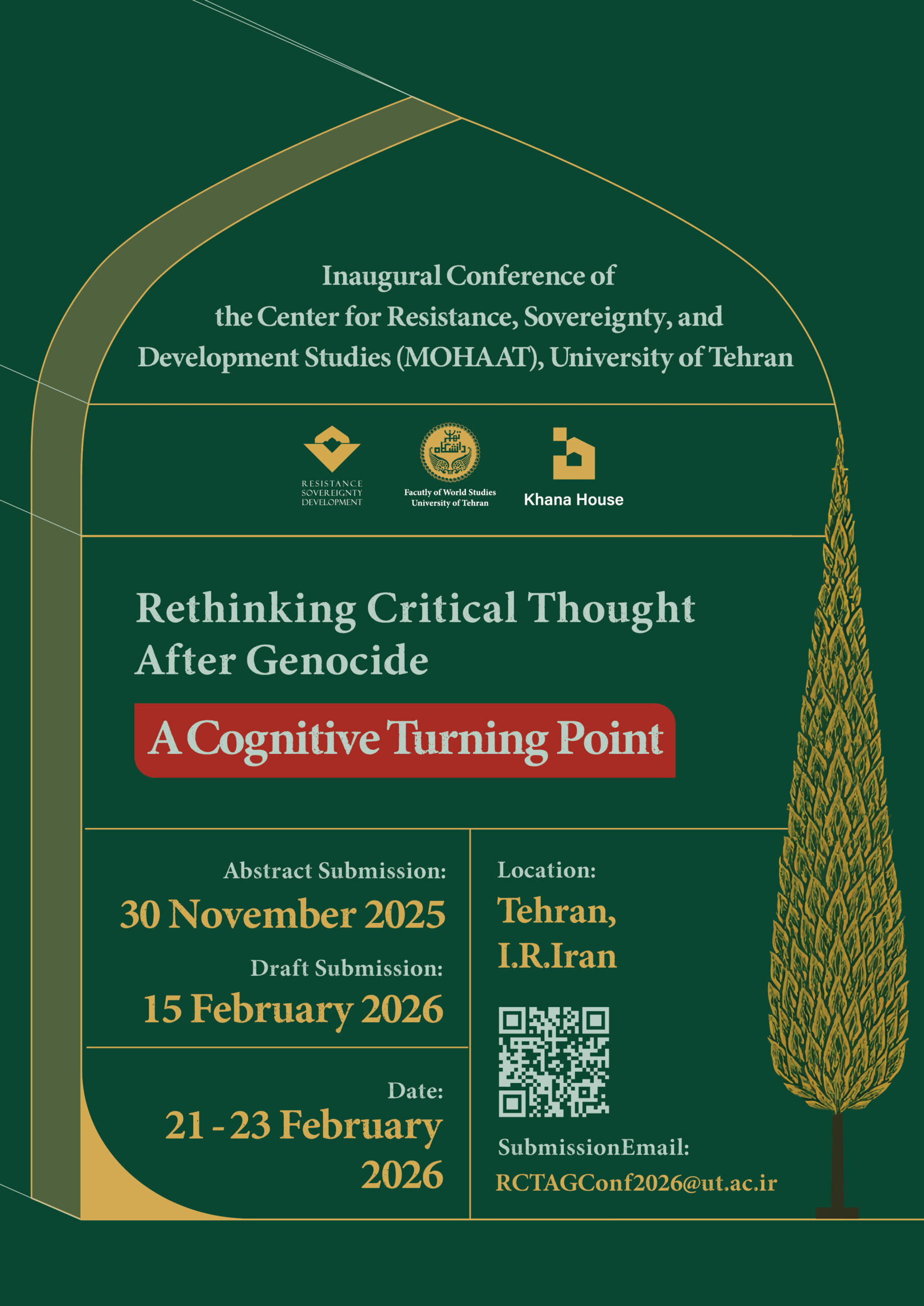
As part of this collective effort, the recently established Center for Resistance, Sovereignty, and Development Studies, strategically located at the University of Tehran, is pleased to announce its inaugural conference, to be held from February 21- 23rd, 2026 in Tehran, Iran. The theme is deliberately broad and multidisciplinary, designed to convene scholars, activists, and students dedicated to exploring anti-colonial resistance in West Asia.
We welcome scholars from diverse disciplines, including international political economy, decolonial studies, West Asian and Middle Eastern studies, socio-legal studies, critical geography, cultural studies, security studies, international relations, sociology, critical international law, development studies, and political science. We invite contributions that challenge dominant and Western critical paradigms and advance southern epistemologies for our shared global future. This serves as part of the larger aim of the Center to function as a hub for paradigm-shifting research and pedagogical interventions, focusing on the anti-systemic struggles in the Arab-Iranian region and collaborating with other initiatives in the Global South.
Conference Themes
The conference will be organized around four core themes that explore and expand on the overarching subject of Rethinking Critical Theory After Genocide. Each theme engages with critical questions to deepen our understanding of the intersections between resistance, sovereignty, and development.
1. Genocide as a Cognitive Turning Point
The silence of Western critical scholars, and their complicity through the co-optation of radical thoughts and the delegitimization of resistance narratives, have epistemically contributed to enabling the genocidal war in Palestine and the expansion of Zionist-US violence in Arab-Iranian region. This moment compels scholars and thinkers from the Global South to intensify their efforts in challenging Western authority over knowledge and narrative production, critical or otherwise. This theme positions the Resistance Front in the Arab-Iranian region as central to global anti-imperialist and anti-colonial struggles, and particularly Palestine as a moral, political, and intellectual compass for revisiting the theories and narratives of dominance and resistance worldwide.
-
- Liberalism and persistence of genocide
- Rethinking modernity and coloniality
- Boundaries of Western Criticality: cognitive, epistemological, and institutional silences and complicity in Western critical thoughts
- Western academia’s co-optation of Marxist and decolonial theories in the service of Imperialism
- The role of the Western intelligentsia in shaping images and actions regarding Arab-Iranian region
- Legitimacy and Illegitimacy of the Resistance: Eurocentric narratives of anti-Imperial struggles
- Orientalist representations and demonization of anti-imperialist forces in Arab-Iranian region
- Contributions of Western critical thoughts in subjugation of Arab-Iranian region
- Epistemic justice post Genocide: the struggle for cognitive authority over the framing and narrating resistance movements
- Unearthing the overt and covert dynamics of anti-Muslim racism in Western media, academia, and institutions
- Reclaiming Narratives: Countering Western media dominance post October 7th
- Geneology of anti-systemic knowledge production in Arab-Iranian region
2. Imperialism and Global Capitalism
This theme examines the deep and inseparable relationship between imperialism and capitalism, emphasizing how these systems sustain each other within the global order following the genocide. It interrogates the mechanisms through which imperialism enforces capitalist exploitation and domination, both economically and politically, across the world. Topics under this theme will critically examine how the US-led imperialism deploy genocide, military aggression, economic sanctions, hybrid warfare, and ideological control to maintain global hierarchies. Special attention is given to the role of Zionism in relation to imperialism and the broader geopolitical dynamics.
-
- The link between genocide and order-making in global capitalism
- Revisiting theories of (neo)colonialism and settler-colonialism
- The principal contradiction in the world system: capital and US-led imperialism
- Rethinking the relationship between imperialism and Zionism
- Hybrid warfare, destabilization, and regime change in Arab-Iranian region
- The interwoven dynamics of racism, capitalism, and imperialism
- Unilateral and multilateral economic sanctions as tools of imperialist domination
- Political economy of Neoliberalism: impacts on class composition, sovereignty, and resistance in Arab-Iranian region
- Deconstructing the myth of ‘non-Western imperialism’ in the age of global capitalism
- Imperialism and development: From underdevelopment to de-development in Arab-Iranian region
- The struggles for sovereignty in the context of Zionist-Imperialist aggressions
- Mapping the link between imperialism and geopolitics of energy, water, and trade corridors
- Political Ecology of imperialism, war, and genocide
- Technologies and strategies of surveillance, terror and genocide
3. Anti-Imperialism and Moqawama
This theme explores the role of Moqawama (Resistance) within global anti-colonial and anti-imperialist movements, highlighting its transformative impact on power dynamics, sovereignty, and justice in Arab-Iranian region and beyond. It critically engages with the challenges and obstacles to form international solidarity with the resistance movements, particularly in the Arab-Iranian region, while also addressing contradictions and barriers within these movements. In addition, the theme discusses decolonial traditions such as reparations and South-South solidarity in advancing a global anti-imperialist front.
-
- Re-positioning Palestinian resistance as the forefront of anti-imperialist struggles
- Situating Moqawama within the broader trajectory of global anti-colonial resistance movements
- Examining the role of Arab-Iranian Resistance Front as a force within the struggles against global capitalism and imperialism
- Regime change, hybrid warfare, and the reconfiguration of the Resistance Front
- Anti-imperialist Resistance and class struggles in the Arab-Iranian Region: points of divergence and paths to unity
- The entrenchment of anti-Iran and anti-Arab sentiments and anti-Muslim racism within Western left secularism and orientalism as a structural barrier to international solidarity movements
- Reparations in the context of genocide, sanctions, and war: a South-centered vision of transformative justice and accountability
- Navigating the Resistance in the Arab-Iranian Region: contradictions and challenges
- From Resistance Front to global anti-imperialist front: bridging geographies, cultures, and ideologies through South-South Solidarity
- International solidarity after genocide: diverse resistance ideologies and liberation theologies
- Resistance as a methodology for knowledge cultivation
4. Old and New World Order
The intensification of the U.S. war machine, the crisis of the dollar’s hegemony, and the crisis of cosmopolitan ideologies have marked a violent and transformative shift in the decline of U.S. imperialism. These dynamics have not only underscored the crisis of the global order but have also revealed the limits of the mechanisms that sustain it. This decline must also be understood as a rupture—one that opens space for imagining and constructing alternative futures. This theme situates the decline of the U.S. empire as a pivotal moment in global anti-imperialist struggles, emphasizing the emancipatory potential of pluripolarity. It examines the Global South’s central role in reimagining a polycentric global political, legal, and economic order; it highlights the emancipatory potential of anti-imperial resistance, the reassertion of sovereignty, and the reconfiguration of global mechanisms of governance.
-
- Genocide in and through international legal frameworks and institutions
- The future of the United Nations: Reform, abolition, and the possibilities of alternative global governance structures
- The critique and limitations of Third World Approaches to International Law: examining the movement and methodology, and its blindspot of anti-imperial Resistance in Arab-Iranian region
- Alternative South-centered visions for a New International Legal Order
- The revival of the New International Economic Order
- Yemen as a Military, Legal and Political Force Preventing and Punishing Genocide
- The role of China, Russia, and Iran in challenging the imperialist bloc and advancing towards pluripolarity
- Examining the potentials, challenges, and limitations of BRICS+ as an emerging international institution in shaping a multipolar world order
- Human Rights post Genocide: Impotence and complicity of the Western-led human rights regimes
- Alternatives to Western (neo)liberal Human Rights informed by practices of anti-colonial Resistance